Long-acting, highly effective, and reversible - an IUD may suit your contraception needs.
What Is an IUD?
An intrauterine device (IUD) is a small, T-shaped contraceptive device inserted into the uterus by a doctor. It provides long-term pregnancy prevention - from 3 to 10 years depending on type - and can be removed at any time if you decide to conceive. IUDs are among the most effective forms of reversible contraception available.
Types of IUDs Available in Singapore
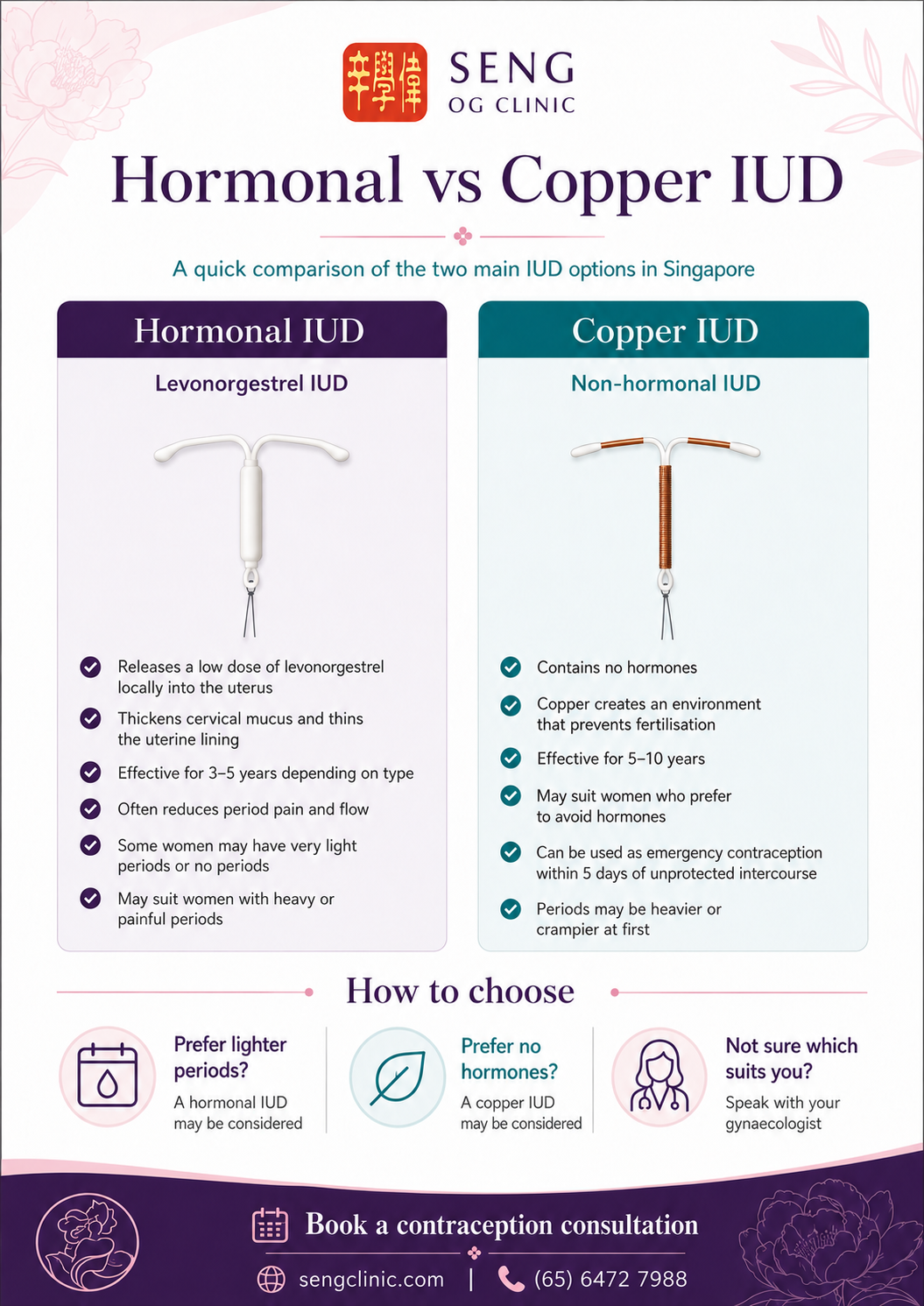
There are two main categories of IUD. Your gynaecologist will help determine which is more appropriate based on your health history, menstrual pattern, and contraceptive goals. If you are still comparing birth control methods, you may also read our contraception guide before deciding whether an IUD is right for you. A hormonal IUD may also be called an intrauterine system (IUS), while a copper IUD is non-hormonal.
Hormonal
Levonorgestrel IUD
Releases a low dose of levonorgestrel locally into the uterus, thickening cervical mucus and thinning the uterine lining.
- Effective for several years, depending on the device type
- Often reduces period pain and flow
- May stop periods altogether in some women
- Suitable if you have dysmenorrhoea or heavy periods
Non-Hormonal
Copper IUD
Contains no hormones. Copper ions create an environment toxic to sperm, preventing fertilisation.
- Effective for 5-10 years
- Suitable if you prefer to avoid hormones
- Can be used as emergency contraception within 5 days of unprotected intercourse
- May increase menstrual flow and cramps initially
Who Is an IUD Suited For?
IUDs are appropriate for a wide range of women. During your consultation, your doctor will review your gynaecological history to confirm suitability. IUD counselling and insertion are part of our gynaecology services at Seng OG Clinic.
| Profile |
Generally suitable? |
|
Women who have completed their family or want long-term contraception
|
Yes
|
|
Women who prefer not to take daily oral contraceptives
|
Yes
|
|
Women who cannot use estrogen-containing contraception
|
Yes - copper and hormonal IUDs are both estrogen-free
|
|
Women who have not yet had children
|
Yes - suitability is assessed case by case
|
|
Women with heavy or painful periods
|
A hormonal IUD may help
|
|
Women with unexplained uterine cavity abnormalities
|
Requires review first
|
|
Women with active pelvic inflammatory disease (PID)
|
Not recommended until resolved
|
What Happens During IUD Insertion
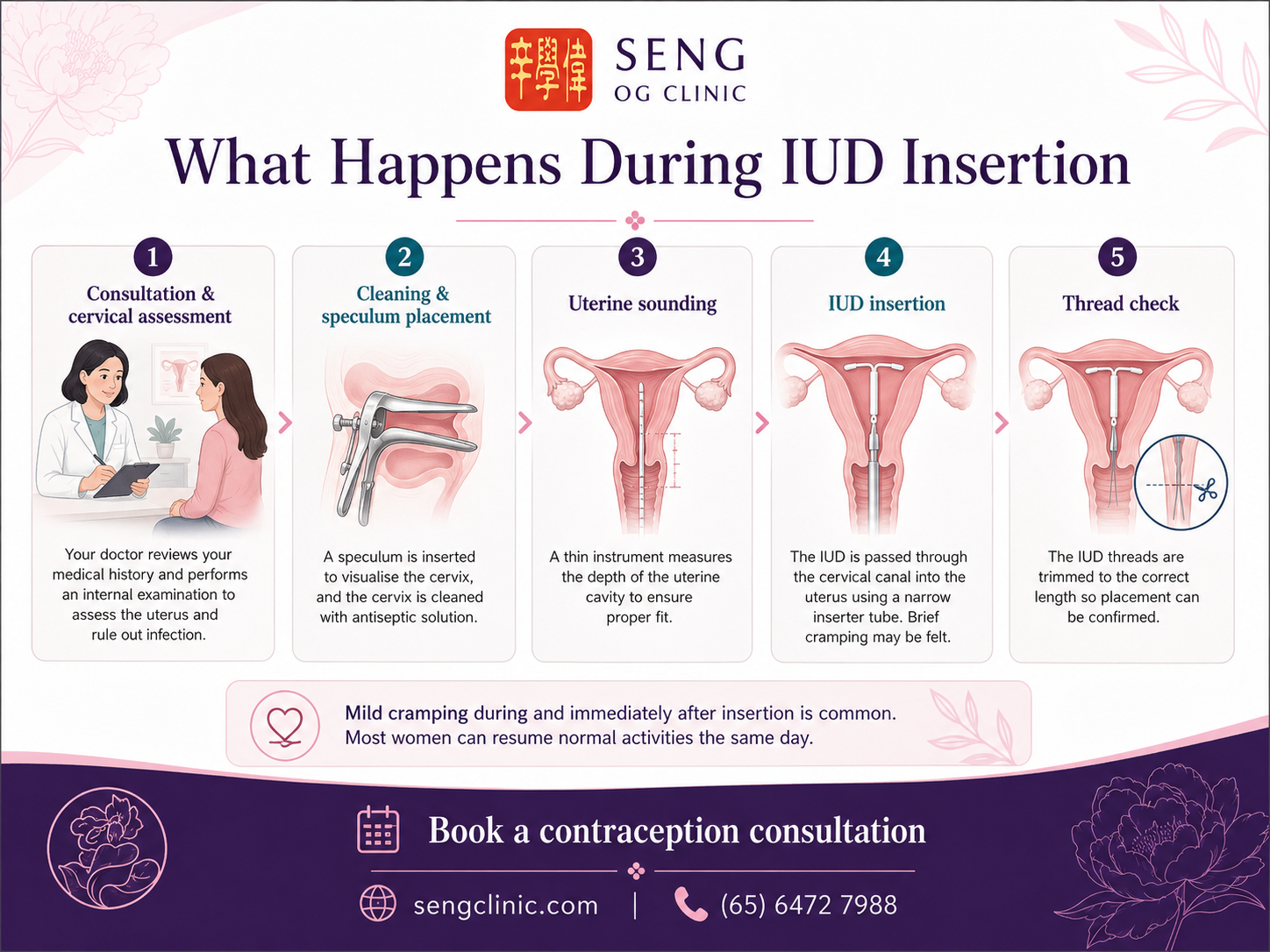
IUD insertion is a brief in-clinic procedure, typically taking around 5-10 minutes. Many women choose to have it done during or just after their period, when the cervix is naturally slightly more open.
- Consultation and cervical assessment - Your doctor will review your medical history and perform an internal examination to assess the position and size of your uterus, and to rule out any existing infection.
- Cleaning and speculum placement - A speculum is inserted to visualise the cervix. The cervix is cleaned with an antiseptic solution.
- Uterine sounding - A thin instrument is used to measure the depth of the uterine cavity to ensure the IUD will fit properly.
- IUD insertion - The IUD is passed through the cervical canal and placed into the uterus using a narrow inserter tube. You may feel a brief cramping sensation at this point.
- Thread check - The IUD has fine threads that extend into the upper vagina, allowing you and your doctor to confirm correct positioning. These threads are not normally felt during intercourse.
Mild cramping during and immediately after insertion is common. Most women are able to resume normal activities the same day, though we recommend resting for a short while post-procedure.
Aftercare and What Is Normal
Understanding what to expect in the days and weeks after insertion helps you distinguish normal adjustment from something that needs review.
Cramping During the First Few Days
Mild to moderate period-like cramps for 1-3 days after insertion are expected. Ibuprofen taken before your appointment can help, provided it is suitable for you.
Spotting or Irregular Bleeding
Light spotting or irregular bleeding for several weeks is normal, particularly with a hormonal IUD. This usually settles within 3-6 months.
Period Changes With a Hormonal IUD
Periods often become lighter, shorter, or less frequent. Some women's periods stop altogether - this is safe and reversible.
Period Changes With a Copper IUD
Periods may be heavier or more painful in the first few months. This typically improves after the initial adjustment period.
Thread Self-Checks
Check for the IUD threads once a month, after your period. If you cannot feel the threads or feel something hard, contact the clinic.
Follow-Up Appointment
A review is recommended 4-6 weeks after insertion to confirm correct positioning. After that, regular cervical smears continue as usual.
Warning Signs - Seek Medical Attention
- Severe or worsening pelvic pain or cramps not relieved by analgesia
- Fever or chills in the days following insertion
- Unusual or foul-smelling vaginal discharge
- You cannot feel the IUD threads, or you feel the hard plastic of the IUD at the cervix
- Suspected pregnancy or a positive pregnancy test while the IUD is in place
These symptoms are uncommon, but prompt review is important. Contact Seng OG Clinic or go to the nearest emergency department if symptoms are severe.
Frequently Asked Questions
IUDs are over 99% effective, making them among the most reliable reversible contraceptive options available. Effectiveness does not depend on daily compliance, unlike oral contraceptive pills.
Fertility returns quickly - often within the first menstrual cycle after removal. There is no lasting impact on fertility from long-term IUD use. If you are planning to conceive, your doctor can advise on the best timing for removal.
Most women experience cramping during insertion, ranging from mild discomfort to more significant pain. The procedure itself is brief. Taking an analgesic one hour beforehand and having the procedure done during your period can help manage discomfort.
The IUD itself sits inside the uterus and should not be felt during intercourse. Occasionally, a male partner may feel the threads; if this is uncomfortable, the threads can be trimmed slightly at a follow-up appointment.
Yes. IUDs are suitable for women who have not yet had children, though insertion may be slightly more uncomfortable as the cervical canal is narrower. Your doctor will assess suitability during your consultation.
No. An IUD provides contraception only. Condoms remain necessary for STI protection.
An IUS (intrauterine system) is the technical term for a hormonal IUD. Both terms are sometimes used interchangeably. A copper IUD is always non-hormonal. Your doctor can clarify which device is being recommended and why.
Book a Contraception Consultation
Speak with our gynaecologist to discuss whether an IUD is right for you. We will review your health history, answer your questions, and walk you through the options.
Contact Us | Call: (65) 6472 7988