FERTILITY PRESERVATION AT SENG OG CLINIC
Understand your fertility preservation options - and what may suit your situation best.
Introduction: Comparing Two Fertility Preservation Options
If you are considering fertility preservation, you may be deciding between two related but different options: freezing eggs or freezing embryos. Both involve cryopreservation, but the timing, requirements, flexibility, and future use are different.
This guide is designed to help you compare egg freezing and embryo freezing side by side. It summarises the key differences and helps you understand which questions to ask during your consultation.
Egg freezing may be more suitable for women who want to preserve fertility without using sperm at the time of freezing. Embryo freezing may be more suitable for couples undergoing IVF (in vitro fertilisation) or ICSI (intracytoplasmic sperm injection), where eggs are fertilised before being frozen.
Not sure which option applies to you? Book a consultation at Seng OG Clinic or call (65) 6472 7988. Our doctors will assess your medical profile, ovarian reserve, relationship status, and family-planning goals before recommending an appropriate pathway.
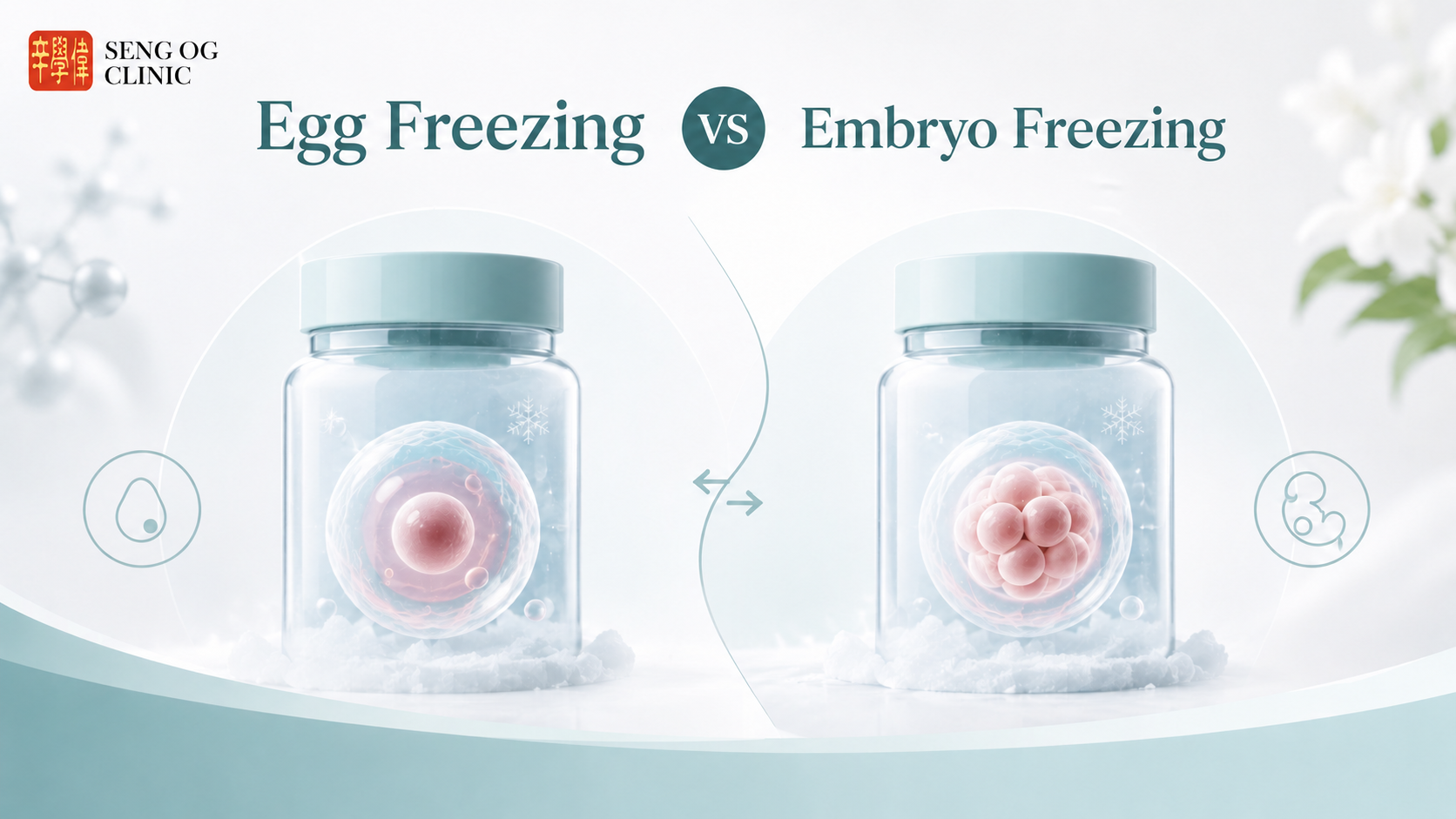
What Is Egg Freezing?
Elective egg freezing, also known as oocyte cryopreservation, preserves unfertilised eggs for possible future use. The eggs are collected after ovarian stimulation, frozen using vitrification, and stored until the woman is ready to use them.
The key difference is that sperm is not needed at the time of freezing. This makes egg freezing a more flexible option for women who are not ready to involve a partner, are not currently in a relationship, or couples who want to keep future family-expansion options open.
When the eggs are used later, they must first be thawed and fertilised through IVF or ICSI to create embryos before embryo transfer can take place.
For full details on the process, suitability, risks, and costs, read our dedicated Egg Freezing Services page.
What Is Embryo Freezing?
Embryo freezing preserves fertilised eggs, or embryos, for possible future use. Unlike egg freezing, embryo freezing requires sperm at the time of treatment because the eggs are fertilised in the laboratory before freezing.
This option is most commonly used during IVF or ICSI treatment when additional good-quality embryos are available after a treatment cycle. These embryos may be frozen and used later in a frozen embryo transfer cycle.
Embryo freezing may be considered by legally married couples who already know they want to preserve embryos together for future family-building.
For full details on embryo cryopreservation, frozen embryo transfer, and IVF-related embryo storage, read our dedicated Embryo Freezing Services page.
Quick Guide: Which Page Should You Read?
- Read the Egg Freezing Services page if you want detailed information on elective egg freezing, ovarian stimulation, egg retrieval, egg storage, suitability, and costs.
- Read the Embryo Freezing Services page if you are undergoing IVF or ICSI and want to understand embryo cryopreservation, frozen embryo transfer, embryo storage, and IVF-related embryo freezing.
- Continue reading this comparison guide if you are deciding between egg freezing and embryo freezing in Singapore and want to understand the key differences before consultation.
Egg Freezing vs Embryo Freezing: Side-by-Side Comparison
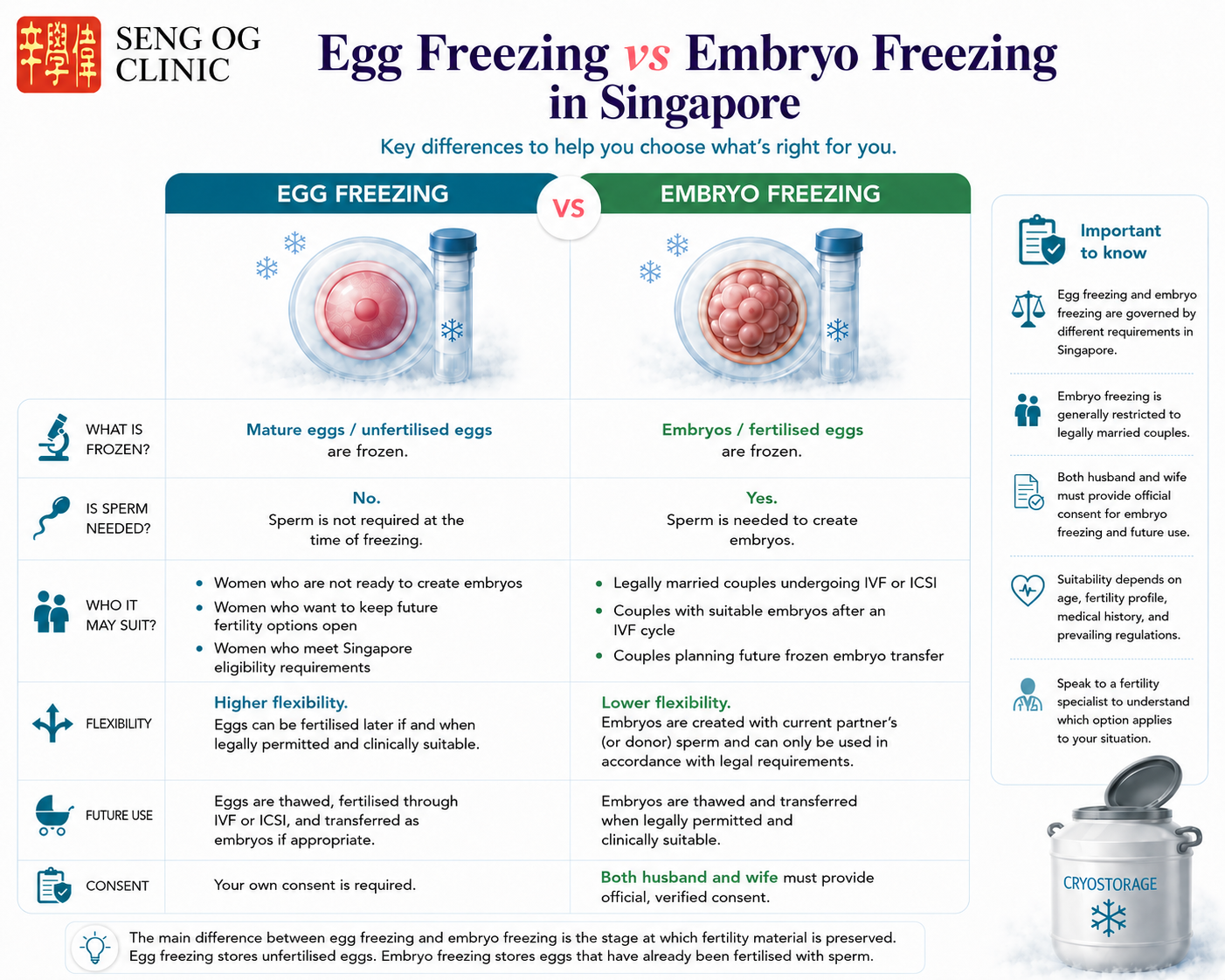
The main difference between egg freezing and embryo freezing is the stage at which fertility material is preserved. Egg freezing stores unfertilised eggs. Embryo freezing stores eggs that have already been fertilised with sperm.
The table below compares the practical differences that patients usually need to consider before discussing options with a fertility specialist.
| Factor |
Egg Freezing |
Embryo Freezing |
| Stage frozen | Unfertilised egg (oocyte) | Fertilised egg (embryo) |
| Sperm required? | No - not needed at the time of freezing | Yes - needed to create the embryo |
| Suitable for | Single women, those without a partner, or those keeping options open | Couples undergoing IVF or ICSI and planning future transfers |
| Fertilisation timing | At the time of future use: thaw, fertilise, then transfer | Already completed before freezing |
| Survival and development information | Fertilisation and embryo development are only known later, when eggs are thawed and used | Fertilisation and early embryo development are already known before freezing |
| Flexibility | High - no partner commitment is required at the time of freezing | The couple should be legally married |
| Regulatory considerations | Subject to MOH eligibility guidelines for elective freezing | Governed by MOH ART guidelines; use is subject to the couple's legal status |
| Most common use | Elective or medical fertility preservation | Surplus embryos after IVF or planned frozen embryo transfer cycles |
Note on Success Expectations
Embryo freezing may give doctors more information before freezing because fertilisation has already occurred and early embryo development can be assessed. However, this does not mean embryo freezing is always the better choice.
Age, ovarian reserve, sperm quality, embryo quality, uterine health, relationship status, consent requirements, and Singapore regulatory considerations all matter. Your doctor will advise based on your individual profile.
Why Embryo Freezing May Offer an Advantage for Some Couples
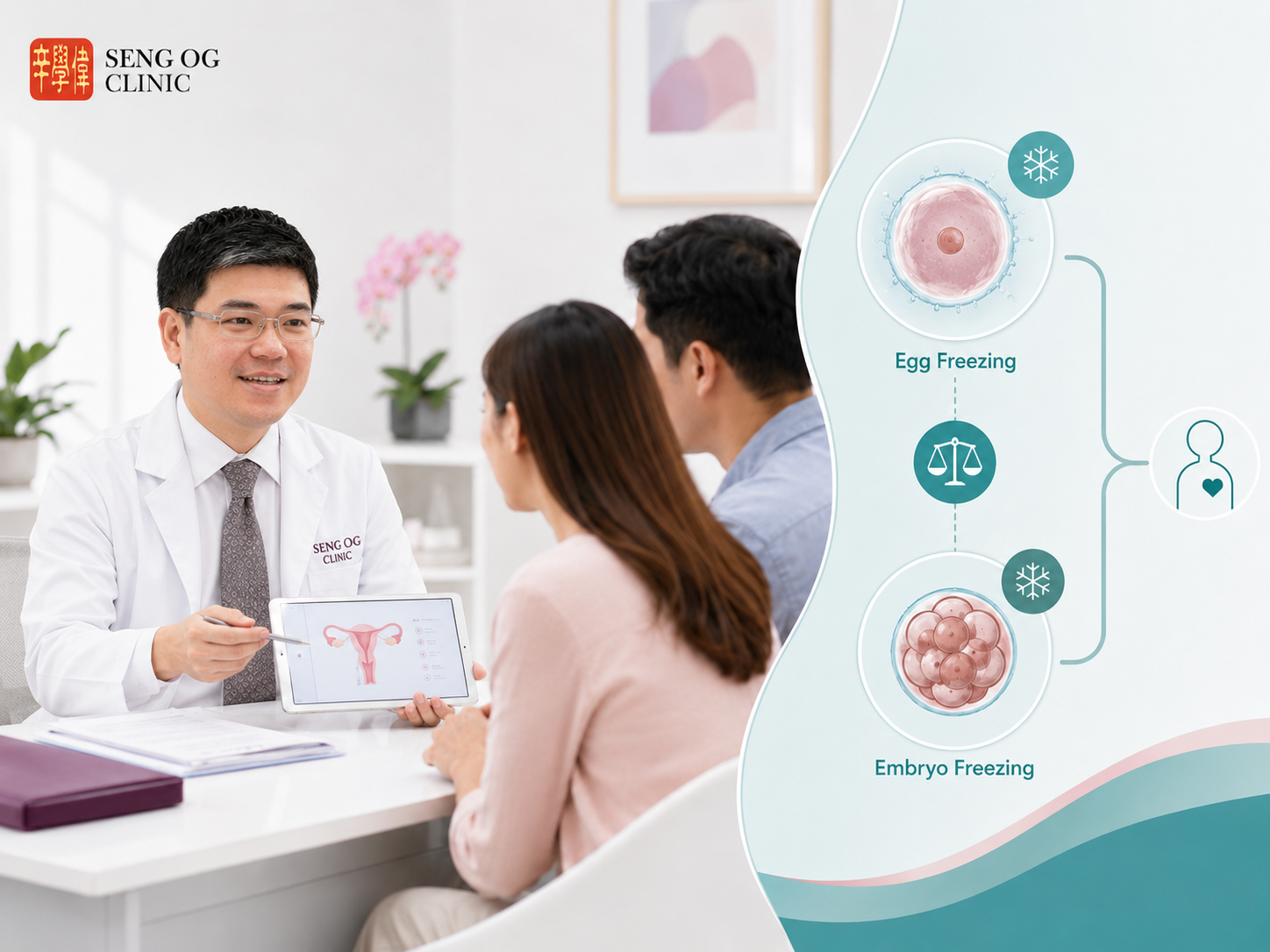
For couples already undergoing IVF or ICSI, embryo freezing can be useful because fertilisation has already taken place before freezing. This gives the medical team more information about how the eggs and sperm have performed together and whether embryos have developed to a suitable stage for cryopreservation.
Embryos are also typically assessed for quality before freezing. This means that only embryos considered suitable for storage are selected for cryopreservation.
However, this does not mean embryo freezing is always the better option. Embryo freezing requires sperm at the time of treatment and involves decisions about embryo consent, storage, and future use. For women who are not ready to involve a partner or do not want to create embryos yet, egg freezing may be the more appropriate option.
At Seng OG Clinic, your doctor will explain the benefits and limitations of each pathway based on your fertility profile and circumstances.
Which Option Might Be Right for You?
Choosing between egg freezing and embryo freezing depends on your personal situation. The decision is not based on success rates alone.
| Patient Profile |
Option |
| Single woman or no partner currently | Egg freezing |
| Wishes to avoid involving a partner in the decision | Egg freezing |
| Facing medical treatment, such as chemotherapy | Egg freezing |
| Legally married couple undergoing IVF or ICSI | Embryo freezing |
| Surplus embryos after an IVF cycle | Embryo freezing |
| Wants more information about fertilisation and development before storage | Embryo freezing |
| Uncertain or not ready for partner commitment | Discuss with your doctor |
Egg Freezing May Be More Appropriate If You:
- Do not currently have a partner
- Are not ready to create embryos
- Want to preserve fertility while keeping future options open
- Prefer not to use donor sperm
- Are considering elective fertility preservation
- Need fertility preservation before medical treatment and time is limited
- Meet the relevant eligibility criteria under prevailing MOH guidelines
Embryo Freezing May Be More Appropriate If You:
- Are legally married and undergoing IVF or ICSI with a partner
- Have sperm available and are ready to create embryos
- Have additional suitable embryos after an IVF cycle
- Are planning a frozen embryo transfer in the future
- Want more information about fertilisation and embryo development before freezing
- Understand and accept the consent and storage considerations involved in embryo cryopreservation
Some patients begin with fertility screening first. Tests such as AMH (Anti-Müllerian Hormone), ultrasound assessment, and semen analysis can help clarify which fertility preservation options may be relevant.
If you are unsure, the best next step is to speak with a fertility specialist. Your doctor can review your age, ovarian reserve, sperm factors, medical history, and goals before advising which option may suit you.
The Process: What Both Options Have in Common
Whether you are freezing eggs or embryos, the early stages are the same:
- Initial consultation and fertility assessment - Hormone tests such as AMH, ultrasound, and a relevant medical history review.
- Infectious disease screening - Standard safety protocols as required for assisted reproduction.
- Ovarian stimulation - Daily hormonal injections over approximately 8-14 days, with monitoring scans and blood tests.
- Egg retrieval - A minimally invasive procedure under sedation, guided by ultrasound.
From this point, the paths diverge:
- Egg freezing: Mature eggs are immediately prepared and vitrified for storage.
- Embryo freezing: Eggs are fertilised with sperm through IVF or ICSI, cultured for several days, and viable embryos are vitrified for storage.
Both procedures are performed at Seng OG Clinic under consistent clinical standards, with individualised protocols tailored to your fertility profile.
Costs and Subsidies in Singapore
Costs differ because egg freezing and embryo freezing are not the same procedure.
Egg freezing costs usually include consultation, ovarian stimulation medication, monitoring scans and blood tests, egg retrieval, laboratory handling, vitrification, and storage.
Embryo freezing costs usually arise as part of an IVF or ICSI cycle. Fees may include IVF laboratory work, fertilisation, embryo culture, embryo vitrification, and storage.
As costs vary depending on medications, monitoring needs, number of cycles, laboratory procedures, storage arrangements, and individual treatment plans, patients should request a personalised estimate after consultation.
Contact Seng OG Clinic for a detailed breakdown of costs based on your assessment and treatment plan.