Both treatments help couples conceive - but they work differently and suit different circumstances. This guide explains how each works, who each is for, and how the decision is made.
The Short Answer
IUI (intrauterine insemination) places prepared sperm directly into the uterus around the time of ovulation - a simpler, less invasive first step. IVF (in vitro fertilisation) involves retrieving eggs, fertilising them in a laboratory, and transferring the resulting embryo into the uterus - a more involved process with a higher success rate per cycle.
The right choice depends on the cause of subfertility, your age, how long you have been trying, and other clinical factors your doctor will assess.
This page is intended as a comparison guide. For detailed treatment steps, preparation, risks, and aftercare, please refer to our dedicated IUI and IVF service pages.
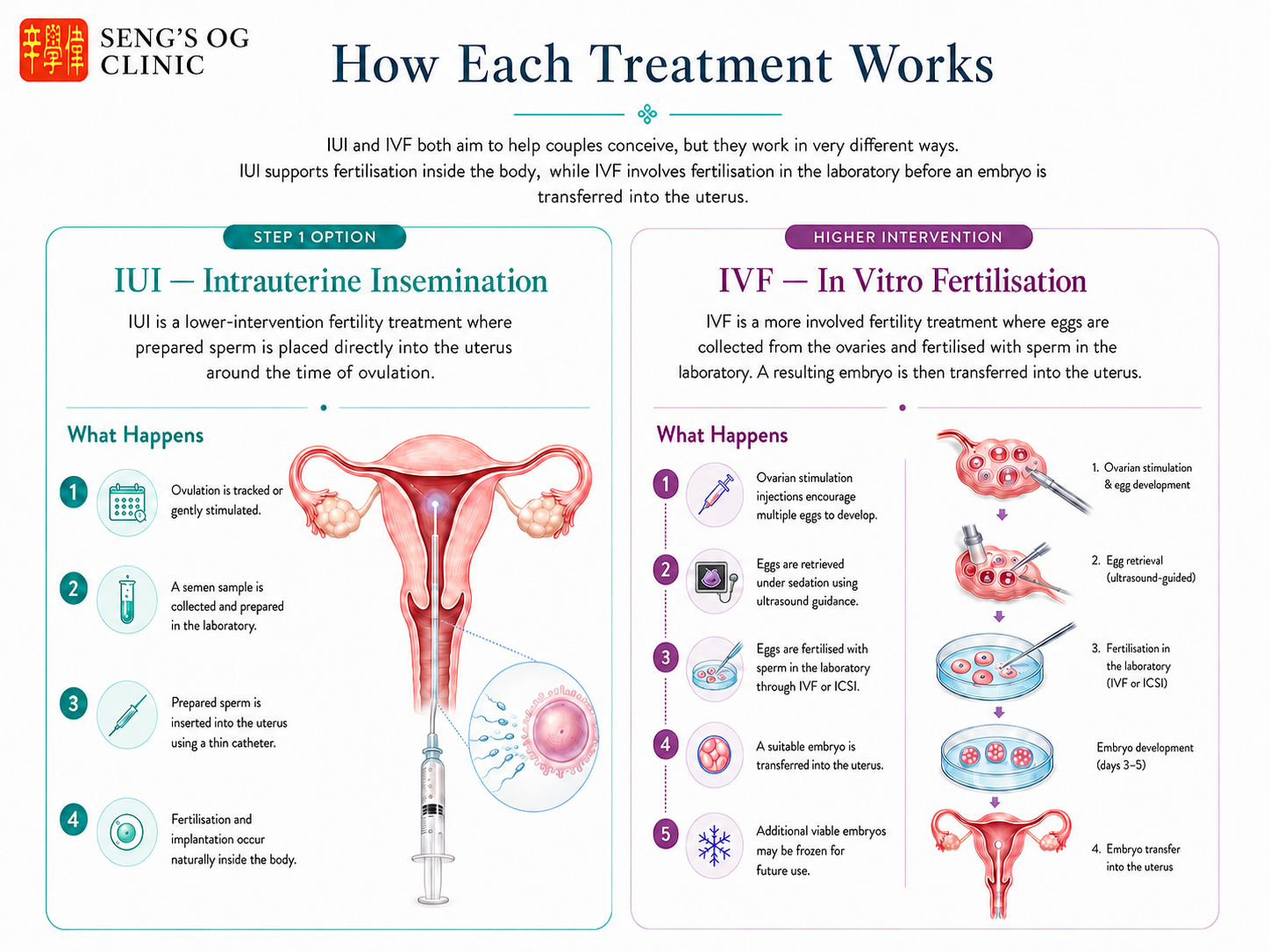
How Each Treatment Works
IUI and IVF both aim to help couples conceive, but they work in very different ways. IUI supports fertilisation inside the body, while IVF involves fertilisation in the laboratory before an embryo is transferred into the uterus.
Step 1 Option
IUI - Intrauterine Insemination
IUI is a lower-intervention fertility treatment where prepared sperm is placed directly into the uterus around the time of ovulation. It may be considered when the fallopian tubes are open, ovulation is occurring or can be supported, and sperm parameters are suitable for insemination.
What Happens
- Ovulation is tracked or gently stimulated.
- A semen sample is collected and prepared in the laboratory.
- Prepared sperm is inserted into the uterus using a thin catheter.
- Fertilisation and implantation occur naturally inside the body.
For a full explanation of the IUI procedure, preparation, risks, and aftercare, read our dedicated IUI Singapore page.
Higher Intervention
IVF - In Vitro Fertilisation
IVF is a more involved fertility treatment where eggs are collected from the ovaries and fertilised with sperm in the laboratory. A resulting embryo is then transferred into the uterus. It may be recommended when IUI is unlikely to work, when there are blocked fallopian tubes, significant male factor infertility, low ovarian reserve, age-related fertility concerns, or previous unsuccessful IUI cycles.
What Happens
- Ovarian stimulation injections encourage multiple eggs to develop.
- Eggs are retrieved under sedation using ultrasound guidance.
- Eggs are fertilised with sperm in the laboratory through IVF or ICSI.
- A suitable embryo is transferred into the uterus.
- Additional viable embryos may be frozen for future use.
For full details on IVF, ICSI, embryo transfer, embryo freezing, and treatment planning, read our dedicated IVF Singapore page.
Seng OG Clinic also offers Slow Release IUI (EVIE), which may be discussed if your doctor feels it is suitable for your treatment plan.
IUI vs IVF at a Glance
Quick Guide: Which Page Should You Read?
- Read this IUI vs IVF page if you are comparing treatment pathways and want to understand when one option may be preferred over the other.
- Read our IUI Singapore page if you want details on the IUI procedure, preparation, risks, and what to expect.
- Read our IVF Singapore page if you want details on IVF/ICSI treatment, embryo transfer, embryo freezing, and treatment planning.
- Continue reading below if you are deciding whether IUI or IVF may be more appropriate based on your age, diagnosis, treatment history, and fertility assessment results.
| Factor |
IUI |
IVF |
| Procedure location |
Clinic (brief, in-room procedure) |
Clinic and theatre - egg retrieval under sedation |
| Fertility medications |
Optional low-dose oral or injectable medication to stimulate ovulation |
Daily injectable hormones over approximately 10-14 days |
| Where fertilisation occurs |
Inside the body, naturally |
In the laboratory |
| Success rate per cycle |
Generally lower per cycle - highly dependent on age, ovulation, sperm quality, and diagnosis |
Generally higher per cycle than IUI - still dependent on age, egg quality, sperm quality, embryo quality, and other clinical factors |
| Cycles typically tried |
2-3 before reassessing |
Often 1-2; frozen embryos may be available for future cycles |
| Relative cost |
Lower |
Higher |
| Risk of multiple pregnancy |
Possible if ovulation medication is used |
Controlled - number of embryos transferred is agreed with your doctor |
| Embryo freezing |
Not applicable |
Yes - surplus embryos can be stored for future use |
These are general figures. Your doctor will provide a more specific picture based on your age and clinical findings.
Who Is Each Treatment Suited For?
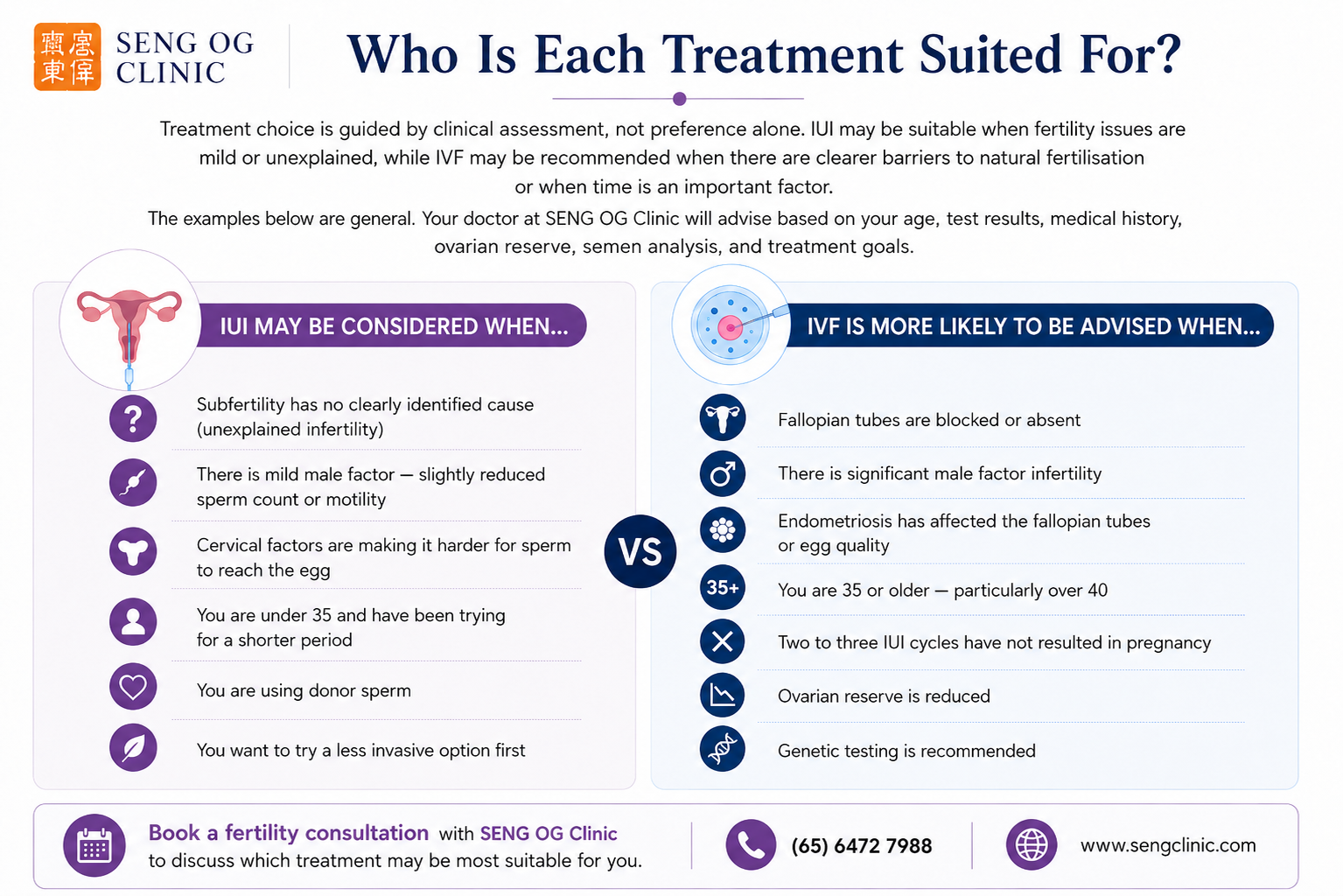
Treatment choice is guided by clinical assessment, not preference alone. IUI may be suitable when fertility issues are mild or unexplained, while IVF may be recommended when there are clearer barriers to natural fertilisation or when time is an important factor.
The examples below are general. Your doctor at Seng OG Clinic will advise based on your age, test results, medical history, ovarian reserve, semen analysis, and treatment goals.
IUI May Be Considered When ...
- Subfertility has no clearly identified cause (unexplained infertility)
- There is mild male factor - slightly reduced sperm count or motility
- Cervical factors are making it harder for sperm to reach the egg
- You are under 35 and have been trying for a shorter period
- You are using donor sperm*
- You want to try a less invasive option first
IVF Is More Likely to Be Advised When ...
- Fallopian tubes are blocked or absent
- There is significant male factor infertility
- Endometriosis has affected the fallopian tubes or egg quality
- You are 35 or older - particularly over 40
- Two to three IUI cycles have not resulted in pregnancy
- Ovarian reserve is low
- Preimplantation genetic testing (PGT) is being considered
* Donor sperm use in Singapore is MOH-regulated and limited to married heterosexual couples with male infertility or hereditary risks.
How the Decision Is Made
The decision between IUI and IVF is usually based on fertility assessment results rather than preference alone. Your doctor will review factors such as age, ovarian reserve, ovulation, fallopian tube status, semen analysis, how long you have been trying, and any previous treatment history.
A general pathway may look like this:
- Start with fertility assessment - Blood tests, ultrasound, semen analysis, and a review of your history help identify the likely cause of subfertility.
- Consider IUI if the findings are mild - IUI may be considered when the fallopian tubes are open, ovulation is occurring or can be supported, and sperm quality is suitable for insemination.
- Consider IVF or ICSI if there are stronger clinical indications - IVF or ICSI may be recommended from the outset if the fallopian tubes are blocked, sperm quality is significantly reduced, ovarian reserve is low, age is a concern, or previous IUI cycles have not succeeded.
- Review and adjust after each cycle - The plan should be reassessed after each treatment cycle. Your doctor will advise whether to continue, change approach, or move to a more advanced treatment.
A note on age and timing. Fertility declines with age, influencing both treatment planning and pregnancy success rates in women. Women over 35, and particularly those over 40, may be advised to consider IVF sooner rather than spending multiple cycles on IUI.